
How to Build an AI Content Strategy That Supports SEO, AEO and Conversions
Introduction
Artificial intelligence is changing the way businesses plan, create, and manage content. From finding content ideas to understanding customer behaviour, AI can make many parts of content marketing faster and more efficient. However, simply using AI to produce a large amount of content does not guarantee better results.
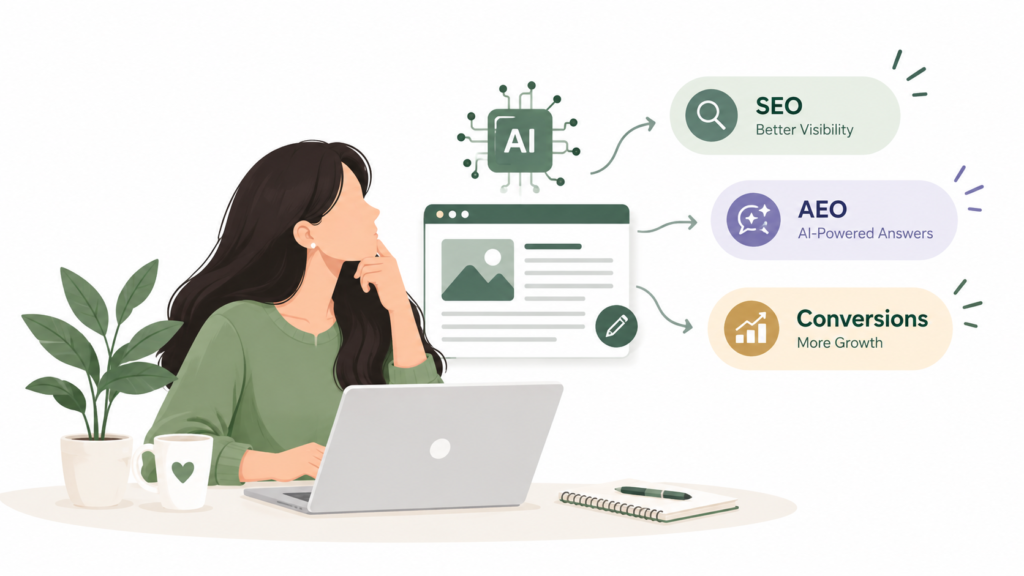
A successful AI content strategy should focus on three important areas: Search Engine Optimization (SEO), Answer Engine Optimization (AEO), and conversions. SEO helps content become more visible in search results, AEO helps content provide clear answers to user questions, and conversion-focused content encourages visitors to take meaningful actions.
When these three elements work together, businesses can create content that attracts the right audience, answers their needs, builds trust, and supports business growth.
1. Understand Your Audience and Goals
Before creating content with AI, the first step is to understand your target audience. AI can help with research, but your content strategy should be based on the actual needs and interests of your customers.
Start by identifying:
- Who your target audience is
- What problems they are trying to solve
- What questions they commonly ask
- What products or services they are looking for
- What action you want visitors to take
Your goal might be increasing organic traffic, generating leads, improving brand awareness, or increasing sales. A clear goal helps you create content that has a specific purpose instead of producing content simply for the sake of publishing.
2. Use AI for Keyword and Topic Research
Keyword research is an important part of SEO. AI tools can help marketers find relevant keywords, identify common search questions, and discover new content opportunities.
Instead of focusing only on broad, highly competitive keywords, look for specific topics that match your audience’s search intent.
For example, instead of targeting only “digital marketing,” you could create content around topics such as:
- How does digital marketing help small businesses?
- How to create a digital marketing strategy
- How can SEO increase website traffic?
- What are the benefits of content marketing?
These specific topics allow businesses to create useful content that directly addresses what their audience is searching for.
3. Create Content That Supports SEO
AI can help with creating outlines, organizing information, identifying related keywords, and improving readability. However, SEO content should always focus on providing genuine value to the reader.
To create SEO-friendly content:
- Use primary and secondary keywords naturally
- Create clear and descriptive headings
- Match content with search intent
- Keep paragraphs short and easy to read
- Add relevant internal links
- Include useful examples and information
- Write clear meta titles and descriptions
The goal should not be to create content only for search engines. Instead, create content that answers the user’s question clearly and provides enough useful information to satisfy their search intent.
4. Optimize Content for AEO
Search behaviour is becoming more conversational. Users are increasingly asking complete questions when using search engines and AI-powered platforms. This makes Answer Engine Optimization (AEO) an important part of modern content marketing.
AEO focuses on making content easy for search and answer systems to understand and use when responding to questions.
To make content more AEO-friendly:
- Use question-based headings
- Provide direct answers to important questions
- Use simple and conversational language
- Organize information with bullet points and lists
- Include relevant facts and examples
- Add FAQs where they provide value
For example, if you are writing about SEO for small businesses, include questions such as “Why is SEO important for small businesses?” and provide a clear answer immediately after the heading.
5. Keep the Human Element in AI Content
AI can make content creation faster, but human creativity and expertise are still important. Content that sounds generic or repetitive may fail to connect with the audience.
AI can help with:
- Generating content ideas
- Creating outlines
- Finding related questions
- Improving grammar and readability
- Repurposing existing content
- Identifying content gaps
However, AI-generated content should be reviewed and improved before publishing. Adding original insights, real examples, industry knowledge, and brand personality can make content more useful and authentic.
AI should support the content creation process rather than completely replace human judgment.
6. Create Content That Supports Conversions
Generating website traffic is important, but traffic alone does not guarantee business growth. Your content should also encourage visitors to take the next step.
Depending on your business, this could include:
- Filling out a contact form
- Requesting a consultation
- Downloading a resource
- Signing up for a newsletter
- Booking a service
- Purchasing a product
Use clear calls-to-action (CTAs) that match the purpose of the content. An educational blog might encourage readers to download a guide, while a service-related article could invite them to contact the business.
7. Measure, Update, and Improve
Publishing content is not the final step. Regularly measuring performance helps businesses understand which topics are working and where improvements are needed.
Important metrics to monitor include:
- Organic website traffic
- Keyword rankings
- Click-through rates
- Engagement and time on page
- Leads and enquiries
- Conversion rates
- Performance of individual blog posts
AI can also help identify patterns and content opportunities based on performance data. Businesses can use these insights to update older articles, improve underperforming pages, and develop new content around successful topics.
Conclusion
Building an AI content strategy is not simply about creating more content in less time. It is about using AI strategically to produce useful, relevant, and goal-focused content.
By combining SEO, AEO, and conversion-focused content, businesses can improve their online visibility, answer customer questions, build trust, and guide visitors toward meaningful actions. AI can make research, planning, writing, and optimization more efficient, while human creativity and expertise ensure that the content remains valuable and authentic.
The most effective approach is to use AI as a supporting tool while keeping audience needs, human insight, and business goals at the center. When these elements work together, content can do more than attract visitors—it can help turn website traffic into meaningful business opportunities.